

2.2 A Snowman Dies
...Being a winter visit to Percy Bysshe Shelley by way of Raymond Briggs
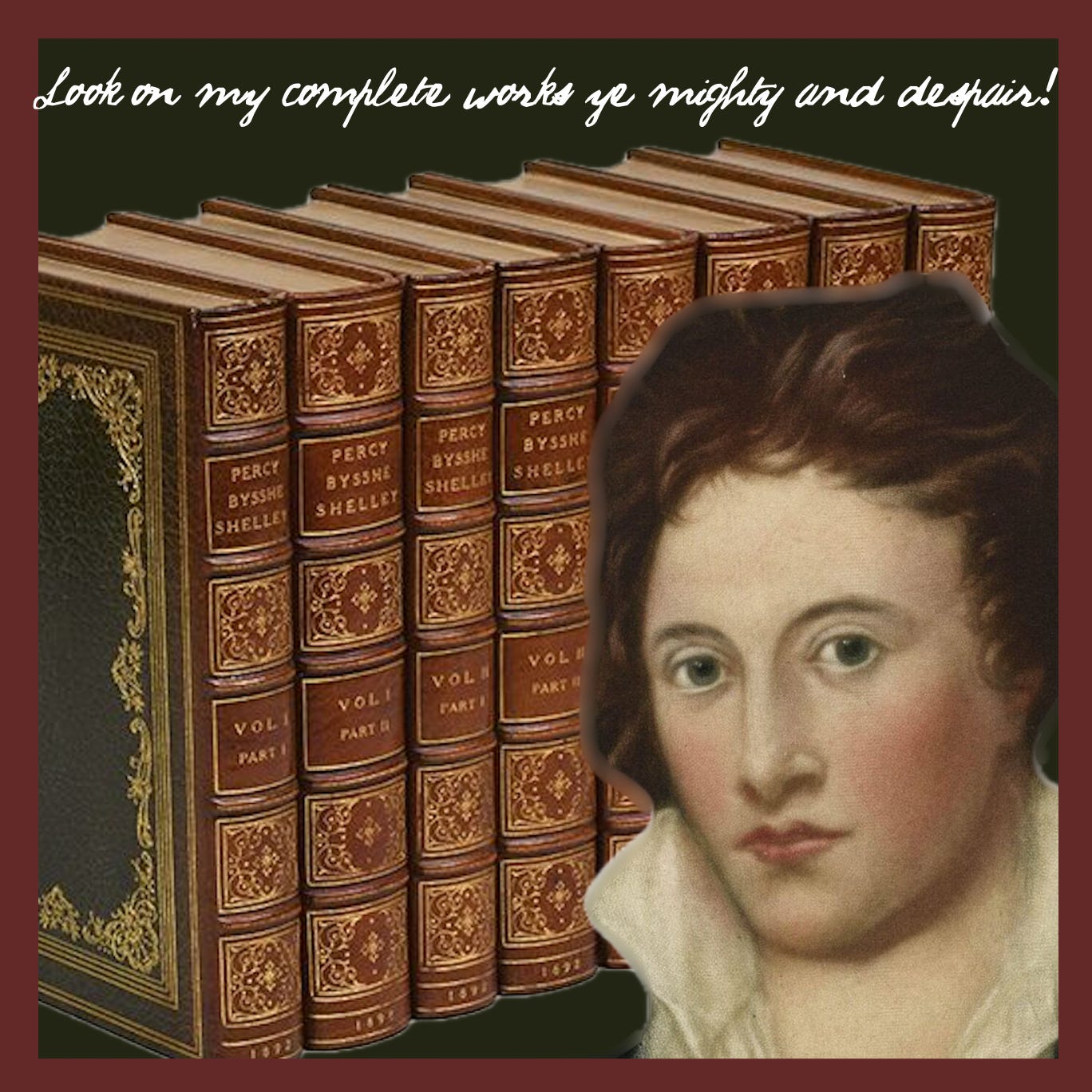
Last week I suggested that there is precious little poetry that has survived for more than a hundred years, earning a place in popular culture, from where it can be referenced, quoted and lampooned and most people will still know the source of it. I suggested that perhaps Wordsworth’s Daffodils and some bits of Shakespeare might fall into that category, but precious little else.
Yet there are a wealth of poems that are common parlance to people who know a little about poetry. These are classic poems, just not quite as universally known.
I reckon that Ozymandias falls into that category. Its a great poem, and if you went to a school where great poetry was systematically studied, or if you enjoy great poetry, you will know of it, but you couldn’t build a stand up routine around it in a comedy club, unless you had an audience full of people who had gone to those schools or read those collections. Perhaps I am wrong. It was used in a trailer for a 2013 episode of Breaking Bad, but then again, how many great pieces of music that I have never heard of do I hear in trailers for TV shows, or used during, and at the beginning and end of them? These things depend upon the taste and knowledge of the producers.
Ozymandias was written by Percy Bysshe1 Shelley in 1818, eight years before Felicia Hemans wrote Casabianca. Unfortunately, Shelley died in 1822, so he never got to read about the boy on the burning deck. He died in a boating tragedy in a storm at sea. He was just 29 years old, the same age as Marc Bolan was when he died 155 years later. Ozymandias is regarded as one of his best pieces, possibly even better than Bolan’s Telegram Sam.
Ozymandias
I met a traveller from an antique land,
Who said—“Two vast and trunkless legs of stone
Stand in the desert. . . . Near them, on the sand,
Half sunk a shattered visage lies, whose frown,
And wrinkled lip, and sneer of cold command,
Tell that its sculptor well those passions read
Which yet survive, stamped on these lifeless things,
The hand that mocked them, and the heart that fed;
And on the pedestal, these words appear:
My name is Ozymandias, King of Kings;
Look on my Works, ye Mighty, and despair!
Nothing beside remains. Round the decay
Of that colossal Wreck, boundless and bare
The lone and level sands stretch far away.”
“Look on my works ye mighty and despair” Is the line that gets me. Shelley could be talking directly to me! He could definitely have been addressing Marc Bolan, Ed Sheeran, or anyone else who might think or have thought that their words will make them immortal. They might be immortal to a dwindling handful of enthusiasts, but as time marches on, an ever increasing proportion of the human race will either see them as irrelevant and completely ignore them, or never even be aware of their existence.
Ironically, the words could also apply to Shelley himself, despite the fact that he is still known over 200 years after his death, how many people (other than poetry enthusiasts) could name any of his poems?
Of course, Ozymandias isn’t actually about poets or pop stars. Maybe it is not even really about powerful kings whose empires are long gone and forgotten. Perhaps it is more about the inevitability of death, and the fact that everything that any one of us says or does will eventually amount to nothing. Which is quite a humbling thought to ponder on.
Ozymandias is the Greek name for Ramesis the Great, who was an incredibly powerful Egyptian warrior Pharaoh. The poem presents him as proud and vain - too focussed on his legacy, and the power that he held. Perhaps he should have chilled out a little, and enjoyed the good things in his ninety years (which might seem a long life, but is a short timespan in the vastness of history). Perhaps, rather than having a huge statue erected to show how mighty he was, he should have just bought a little plaque to remind him to live laugh and love or to dance like there’s nobody watching.
Its not that I want to ridicule Shelley’s words with such thoughts. More that I want to think about the meaning of them. They have me thinking of how we take pride in our achievements and renown, and how fragile and meaningless those things are in the long run.
There are many people who (unlike me) are enthusiastic about gardening. They might grow prize winning vegetables, maybe even beautiful flowers and shrubs. They might exhibit at the Chelsea Flower Show. But after they die, their garden, uncared for, may run to seed. The sign that they put up in the window of the shed which read “Look on my works ye mighty and despair” will seem a poor, empty boast. Someone else will win the biggest marrow competition at next year’s church fête. Life will go on without them, and they will be all but forgotten.
This is what will certainly happen with this Substack, along with all of the poetry on it, and the rest of my thoughts and words. I hope that in all my promotion of it I never come across as all - “Look on my Substack, ye other poets and despair” That would be hubris indeed. All that my writing really does is temporarily please me, and hopefully some of the handful of people who read and perhaps subscribe to it. We should all get out there and dance like theres nobody watching. None of us really know how long we’ve got left to do it2.
We are like snowmen, living for a very short space of time. Whilst they are alive, snowmen see a world made in their own image, everything clean, and white, and sparkling. They live in a world constructed to maintain them, just as we do. But just like us, global warming will get them in the end. Unlike us, it isn’t even their fault.
We enjoy building snowmen. We build them with our kids, just as our parents built them with us. We take time and care to fashion them. we want to build the best snowman in the area. We want to be able to say “Look on my snowman and despair ye neighbouring snowman builders.” It is sad when they melt away, the magic is gone, and our pride in them is just a fading memory
For many people the greatest piece of creative art on the theme of a snowman is the Raymond Briggs 1978 children’s book The Snowman, and the animated film which was made of it in 1982.
I was thinking about that film one day, just after a heavy snowfall had melted . When I saw some bits and pieces in a neighbour’s garden Percy Bysshe Shelley came and joined Raymond Briggs in my imagination and here, for your temporary pleasure, is what I wrote.
A Snowman Dies
I met a man who comes from here around
“A small fast-melting mass of snow” he cried
“Stands in my garden . . . Near it, on the ground,
Forlorn, a single carrot lies. Beside
Two buttons black, and sodden scarf and hat,
Tell that its sculptor aimed for human form
Which now is gone, leaving these lifeless things,
Which in pale sunlight gradually warm
This sad assortment then seemed to declare
‘I was a Snowman! A noble winter king:
Look on what’s left, ye Mighty, and despair!'
Nothing beside remains. Round the decay
Of that once frozen wreck, muddy and bare
A murky garden stretches through a dreary day."
What kind of a name is Bysshe? Who would give their child Bysshe as a middle name? Probably only Mr and Mrs Shelley. Apparently it is a name derived from the surname Bush. As in George W Bysshe.
Actually, this substack is me, dancing like there’s nobody watching. So thanks for watching.
The previous occupants of our house had two of those vacuous quotes on the wall. The one referring to Breakfast at Tiffany's was obliterated with emulsion. We still have one in the conservatory yet to be erased : "Bless this house with love and laughter". Just as well we can't see it from the living room. "Look on my Works, ye Mighty, and despair!" would have been more of an attraction to visitors. 😉
Maybe Bysshe was his mother's maiden name. That's usually how these things work with poets.