

2.44 The Erotic World of Fleas.
John Donne with a fabulous sixteenth century chat-up line

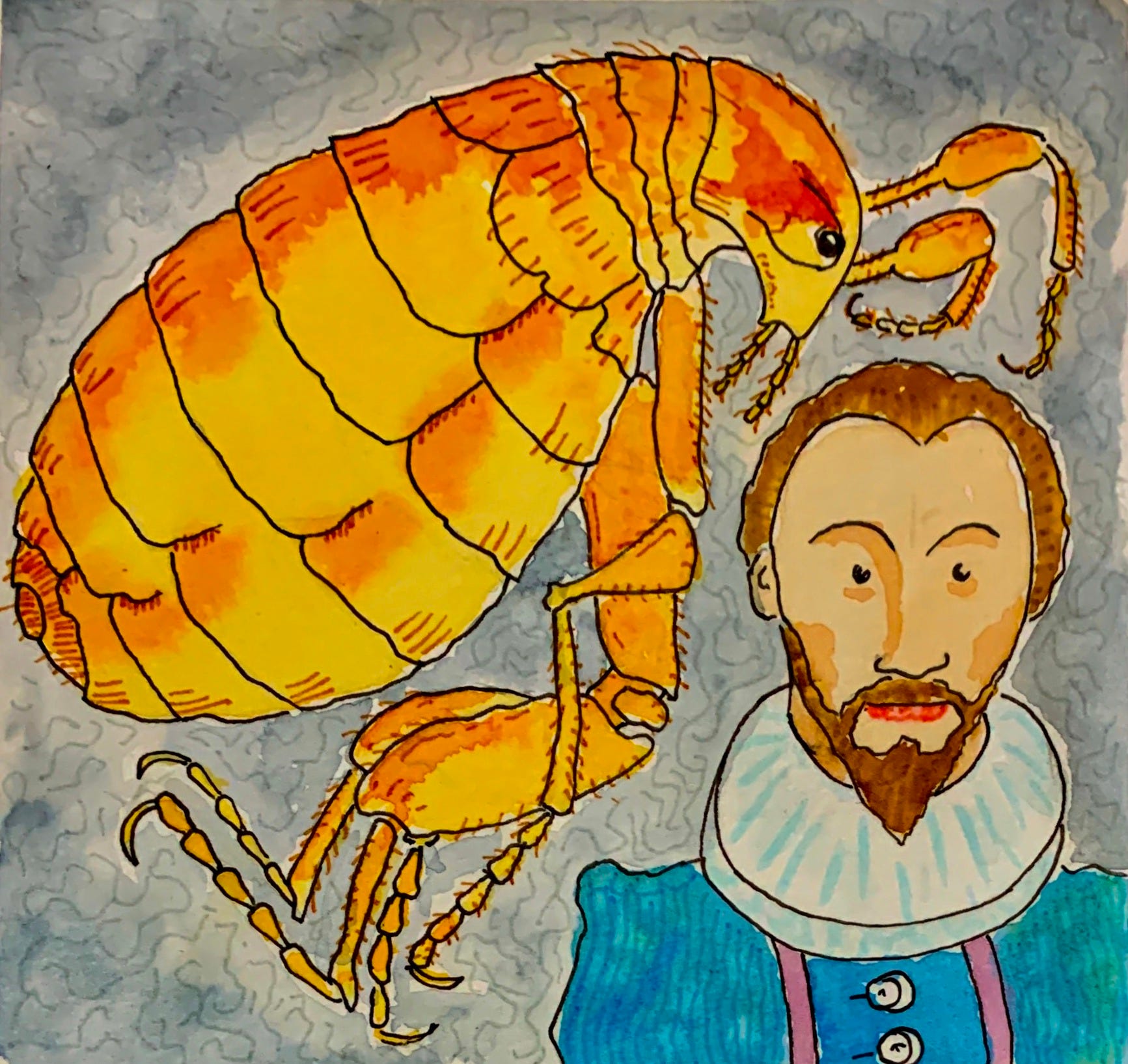
I always thought that John Donne was a one off. There can’t be that many men who have thought it a good idea to try and seduce a woman by talking about a flea that has intervened in a promising moment of intimacy.
Maybe he was the first to take that tack, but amazingly, his poem, The Flea is a part of a renaissance genre of ‘erotic’ flea poems which had its origins back in the days of the Roman Empire.
In Philip Marlowe’s play from the 1590s, Doctor Faustus, a prideful character boasts “I am like to Ovid’s flea, I can creep into every corner of a wench” The flea referred to was from the poem Carmen de Pulice which is recognised by some as being the very first of the genre. It wasn’t actually written by Ovid, but by another Roman poet, Ofilius Sergianus.
It was in the Sixteenth Century that flea poetry really took off. in 1553, the French Poet, Pierre de Ronsard, got hot under the collar about the thought of actually turning himself into a flea. Here is my attempt to translate his sonnet - Poemé 41 of Les Amours1.
The Loves (Poem 41) - Pierre de Ronsard
Oh My God, what lovely graces bloom
In the verdant garden of your breast
The swelling circles of two milky lawns,
Enclose within the arrows of Desire!

I want to change into an animal
When I feast my eyes on your twin peaks,
Like a new rosebush in the spring,
Offering up its roses in the morn

You are like the beautiful Europa
Who Jupiter seduced in bull-like form
Me, I wish that I were a flea!

Daily I’d kiss and bite your lovely breasts
But at night my wish would always be
That I could change once more into a man.
Fleas were a lot more common in those days. People from all walks of life and at all levels of society had them, and whilst they were still a nuisance and an irritation, it was not quite as offputting to notice one on someone as it would be today when it would be something of a red flag on a first date, or indeed any social occasion.
In 1579, a French lawyer and man of letters, Etienne Passquier was visiting an acclaimed poet Catherine DesRoches2, when he noticed a flea on her breast. Perhaps an Englishman would have pretended not to notice, but Passquier took the opportunity to set up a literary competition to see who could write the best poem in praise of the creature. Even Catherine had a go, and three years later, a book was published, La Puce de Madame DesRoches, containing over fifty flea themed poems, in Latin, English and a range of other languages. Even Catherine herself wrote one, which was very sporting of her.
It is uncertain when Donne’s poem was written, but it is likely to have been in the 1590s, when he was a young unmarried lawyer (hence the legal style of his plea to the object of his desires). It wasn’t actually published until 1633, a couple of years after his death
Donne wasn’t going for a cheap gag, he was actually using the flea as an aide to seduction, writing a poem in the wheedling style that Andrew Marvell would employ in his 1649 poem To his Coy Mistress. Perhaps by the time Marvell was writing the craze for flea poems had subsided sufficiently to render them old hat, so he merely points out to the object of his desires that before she knows it she will get old and die, leaving her long preserved virginity to be breached by the worms in the cold, cold ground.
They certainly knew how to turn on the charm in those days.
Perhaps Donne had elevated the erotic flea genre as far as it could go, and subsequent poems were either akin to carry-on comedies or pale imitations of what he had achieved.
The 1590s really is the best bet for when it was written, as it is unlikely that he write it after 1601, the year in which he got secretly married. He was 29 years old and his bride was just 17. Unfortunately for him, she was also his very influential boss’s daughter. His new father in law was so outraged that he not only fired him but had him thrown into prison along with the priest who officiated at the wedding. After his release, he made a living as an MP and latterly a priest. The days when he would write erotic flea poetry were were more than likely well behind him by then.
Is the poem erotic? It isn’t one of the Donne poems in Untermeyer’s Uninhibited Treasury of Erotic Poetry, but there are six others there, including To His Mistress Going to Bed. I would argue that he certainly knew what he was doing with lines such as it sucked me first and now sucks thee, rendered with the archaic medials used in Milton’s Paradife Loft. Others have pointed out the idea of something swelling with blood when pampered as a particularly risqué image.
Erotic or not, it is very clever, with a twist at the end seeing Donne change the tack of his argument after the object of his desires has purpled her thumb by crushing the unfortunate insect. Without missing a beat, he moves on from the suggestion that they are already practically married by their bloods being mingled within its body, to claiming that the loss of her virginity would be no more traumatic or immoral than the killing of the flea was. What a silver tongued lothario!
The Flea - John Donne
Mark but this flea, and mark in this,
How little that which thou deniest me is;
It sucked me first, and now sucks thee,
And in this flea our two bloods mingled be;
Thou know’st that this cannot be said
A sin, nor shame, nor loss of maidenhead,
    Yet this enjoys before it woo,
    And pampered swells with one blood made of two,
    And this, alas, is more than we would do.

Oh stay, three lives in one flea spare,
Where we almost, nay more than married are.
This flea is you and I, and this
Our marriage bed, and marriage temple is;
Though parents grudge, and you, w’are met,
And cloistered in these living walls of jet.
    Though use make you apt to kill me,
    Let not to that, self-murder added be,
    And sacrilege, three sins in killing three.

Cruel and sudden, hast thou since
Purpled thy nail, in blood of innocence?
Wherein could this flea guilty be,
Except in that drop which it sucked from thee?
Yet thou triumph’st, and say’st that thou
Find’st not thy self, nor me the weaker now;
    ’Tis true; then learn how false, fears be:
    Just so much honour, when thou yield’st to me,
    Will waste, as this flea’s death took life from thee.
In researching this piece I came across another two flea poems which, although not of the erotic genre, I really wanted to share with you3.
The first is a surprisingly modern sounding poem from 1872. The title is the scientific name for a type of insect that sucks your blood through plunging a tube into your flesh is clearly related to the word siphon. I love etymology!
Siphonaptera - Augustus de Morgan
Great fleas have little fleas upon their backs to bite ‘em,
And little fleas have lesser fleas, and so ad infinitum.
And the great fleas themselves, in turn, have greater fleas to go on;
While these again have greater still, and greater still, and so on.
The second, another which sounds quite modern to my ears, was written in 1904. It is often wrongly attributed to Ogden Nash, and has been considered as one of the shortest poems of all time (not including the title).
Lines on the Antiquity of Microbes - Strickland Gillian
Adam
Had ‘em.
Have a go at translating it yourself. You can use google translate, and then tweak it to a more poetic form. Thats all I did. You have to take a few liberties, but that’s poetry.
Les Amours Poéme 41 - Pierre de Ronsard
Ha, Seigneur dieu, que de graces écloses
Dans le jardin de ce sein verdelet
Enflent le rond de deus gazons de lait,
Où des Amours les fléches sont encloses !

Je me transforme en cent metamorfoses,
Quant je te voi, petit mont jumelet,
Ains, du printans un rosier nouvelet,
Qui le matin bienveigne de ses roses.

S’Europe avoit l’estomac aussi beau,
De t’estre fait, Jupiter, un toreau,
Je te pardonne. Hé, que ne sui’-je puce!

La baisotant, tous les jours je mordroi
Ses beaus tetins, mais la nuit je voudroi
Que rechanger en homme je me pusse.
From that day on, Catherine was sure to wear her clothing buttoned up all the way to her neck.

A final piece I want to share is this song, which, my dad was able to explain to me when we heard it on the radio one day back in the 70s. He had hidden depths, my dad.
That song's done me 'ead in Mike. Not sure I'll ever be the same. Just going for a bit of a scratch, mate.