

2.45 No, Thank You, John
Christina Rossetti puts a man firmly in his place.

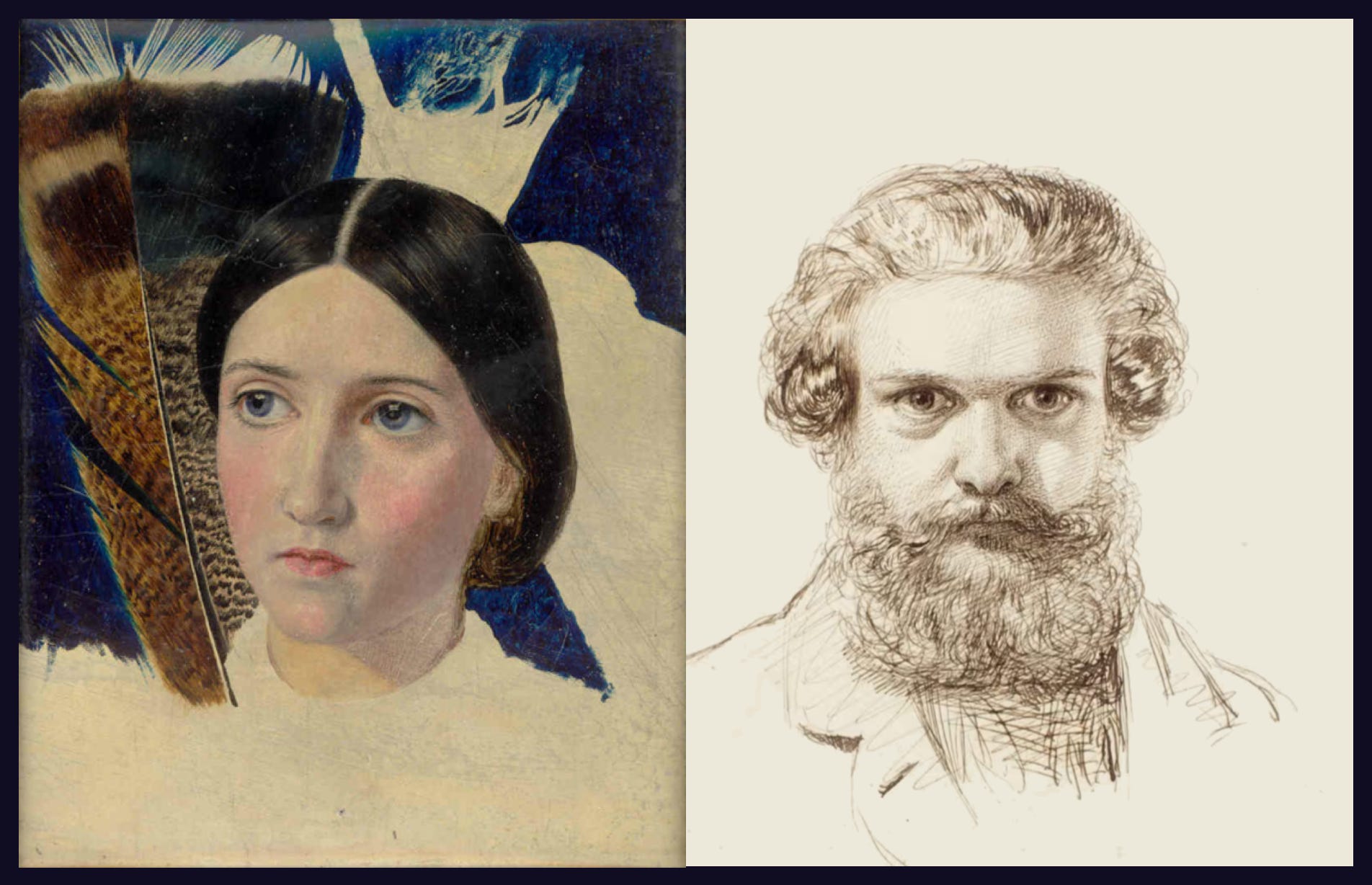
Christina Rosetti lived from 1830 to 1894. She was born in London to a very literary family who had come to England after being exiled from their native Italy due to their political beliefs. Her father was a poet, and her mother was interested in both education and culture, taking responsibility for the education of her four children, all of whom became successful in the arts.
Perhaps her most famous poem is the bizarre, fairytale like allegory Goblin Market, but she was also responsible for In the Bleak Midwinter, the poem that became the well known Christmas carol after being set to music by Gustav Holst. She wrote much more, most of it with religious themes and a good proportion concerned with death and the afterlife. I am particularly fond of the poem No, Thank You, John, which deals with neither of these matters but is a firm refusal of a suitor who she is not romantically interested in. It is a lovely piece which reminds me of receiving such knockbacks myself as a youth, although not quite as well expressed.
Christina never actually married, despite coming close on a couple of occasions. Her deeply held religious beliefs always seemed to get in the way. She was a High Church Anglican and was not prepared to commit herself to anyone who didn’t adhere to her principles, not even lower church Anglicans or actual Roman Catholics. Neither of the two men who she almost ended up with were called John.
The John of No, Thank You, John was more than likely the artist John Brett who painted Christina in 1857 when they were both around 26 years of age. Perhaps he had carried a torch for her throughout the three years from then until she wrote the poem. Maybe even afterwards - you know what blokes are like. He eventually got married to Mary Ann Howcroft in 1871 and went on to have seven kids with her over the following 12 years. Perhaps Christina had a lucky escape. I don’t imagine that she ever had any regrets.
No, Thank You, John - Christina Rossetti
I never said I loved you, John:
Why will you tease me, day by day,
And wax a weariness to think upon
With always “do” and “pray”?

You know I never loved you, John;
No fault of mine made me your toast:
Why will you haunt me with a face as wan
As shows an hour-old ghost?

I dare say Meg or Moll would take
Pity upon you, if you’d ask:
And pray don’t remain single for my sake
Who can’t perform that task.

I have no heart? - Perhaps I have not;
But then you’re mad to take offence
That I don’t give you what I have not got:
Use your common sense.

Let bygones be bygones:
Don’t call me false, who owed not to be true:
I’d rather answer “No” to fifty Johns
Than answer “Yes” to you.

Let’s mar our pleasant days no more,
Song-birds of passage, days of youth:
Catch at to-day, forget the days before:
I’ll wink at your untruth.

Let us strike hands as hearty friends;
No more, no less: and friendship’s good:
Only don’t keep in view ulterior ends,
And points not understood

In open treaty. Rise above
Quibbles and shuffling off and on:
Here’s friendship for you if you like; but love,
- No, thank you, John.
Another joy about this poem for me, is that it brings to mind a song that I remember singing at school. Oh No John is an old Folk song, according to Wikipedia a bowdlerised version of it was taught to English Schoolchildren in the 1950s. It would have been the late sixties or early seventies when me and my classmates were encouraged to sing along with it by a long forgotten teacher hammering away on the ancient school piano.
A version of the song was broadcast by the BBC in 1965 as a part of their Schools Radio programme Singing Together1. Maybe the Wikipedia writer was thinking of that version and misplaced the decade.
The BBC provided schools with printed booklets containing the words and music to the songs that would be featured each term. Here is their version of Oh No John.
Oh No John
On yonder hill there stands a creature,
Who she is I do not know.
I’ll go and court her for her beauty;
She must answer Yes or No.
O No John! No John! No John! No!

My father was a Spanish captain -
Went to sea a month ago,
First he kissed me, then he left me -
Bid me always answer No.
O No John! No John! No John! No!

O Madam in your face is beauty,
On your lips red roses grow,
Will you take me for your lover?
Madam, answer Yes or No.
O No John! No John! No John! No!

O Madam since you are so cruel,
And that you do scorn me so,
If I may not be your lover,
Madam, will you let me go?
O No John! No John! No John! No!

O hark! I hear the church bells ringing,
Will you come to be my wife?
Or dear Madam, have you settled
To live single all your life?
O No John! No John! No John! No!
It is strange to recall myself happily singing this tune even outside of the classroom, maybe on the way home, or maybe even when I was at home, for the entertainment of my parents. If I got to the last verses, I certainly didn’t have any understanding of the twist at the end and how the creature (I’m sure that we sang maiden actually) subtly changes her attitude to John’s advances.
Other, un-bowdlerised versions of the song are available in which the Spanish captain was her husband rather than her father, and John’s aims don’t include wedding bells. In these versions things get a little too forward for innocent 1960s schoolboys.
Oh No, John - some verses that the BBC didn’t distribute to schools
Stooping down to tie your garter,
Just an inch above your knee,
If my hand should slide up farther
Would that be any harm to thee?
O No John! No John! No John! No!

Now we’ve lain all night together
Hark, the cocks began to crow;
Now the daylight is appearing
Unclose your arms and let me go
Oh no John, No John, No John, No!

One more thing I have to ask you
That’s before I let you go,
Did you ever sleep more sweeter,
Were you ever cuddled so?
Oh no John, No John, No John, No!
I’m sure that there are versions which include alternative words for cuddled but I decided not to seek them out.
What I would dearly like to know is if Christina Rossetti had heard of this song when she wrote the poem. My initial reaction is to dismiss this as a ridiculous flight of fancy. She had been brought up in a deeply religious family and remained almost obsessively devout throughout her life.
However, from 1859 - 1870 she volunteered at the St. Mary Magdalene Penitentiary in Highgate, an institution which aimed to rehabilitate and provide refuge to fallen women. Perhaps she had heard the song there, and the idea of how she might say a more forcible No to her own John had stuck in her mind. You never know.
Singing Together was broadcast to schools every week during term time for may decades from the beginning of World War Two (when it was considered as a means of both cheering up and forging a new sense of community amongst refugees) It is probably the programme in which my eight year old Dad learned Michael Finnegan. I myself remember lessons featuring not only Oh No John, but also Molly Malone and Donkey Riding, (another one that was heavily edited for the kiddies) I can still sing these tunes even now although I am very rusty on the words.
The programme was discontinued in the 1990s, victim to the National Currriculum, which was responsible for removing a great deal of joy from classrooms. (Another thing to thank Thatcher for) There is an excellent radio programme about it, presented by Jarvis Cocker on BBC Sounds
Knowing that she wrote the lyrics for "In The Bleak Midwinter" adds a bit of depth to some of their words ("What can I give Him, poor as I am?").
That song (with the tamer version of the lyrics) still often comes into my head, and not just because I share a name with one of the protagonists. And if I do mention the earworm aloud, it's usually to blank looks - so, no, thank *you*, Mike, for this lovely piece, to wake up to of a Sunday morning ❤️