

7. Tollund Man
... being a reflection on the the discovery of a remarkably peaceful looking man, dead in the marshes, with a noose around his neck.

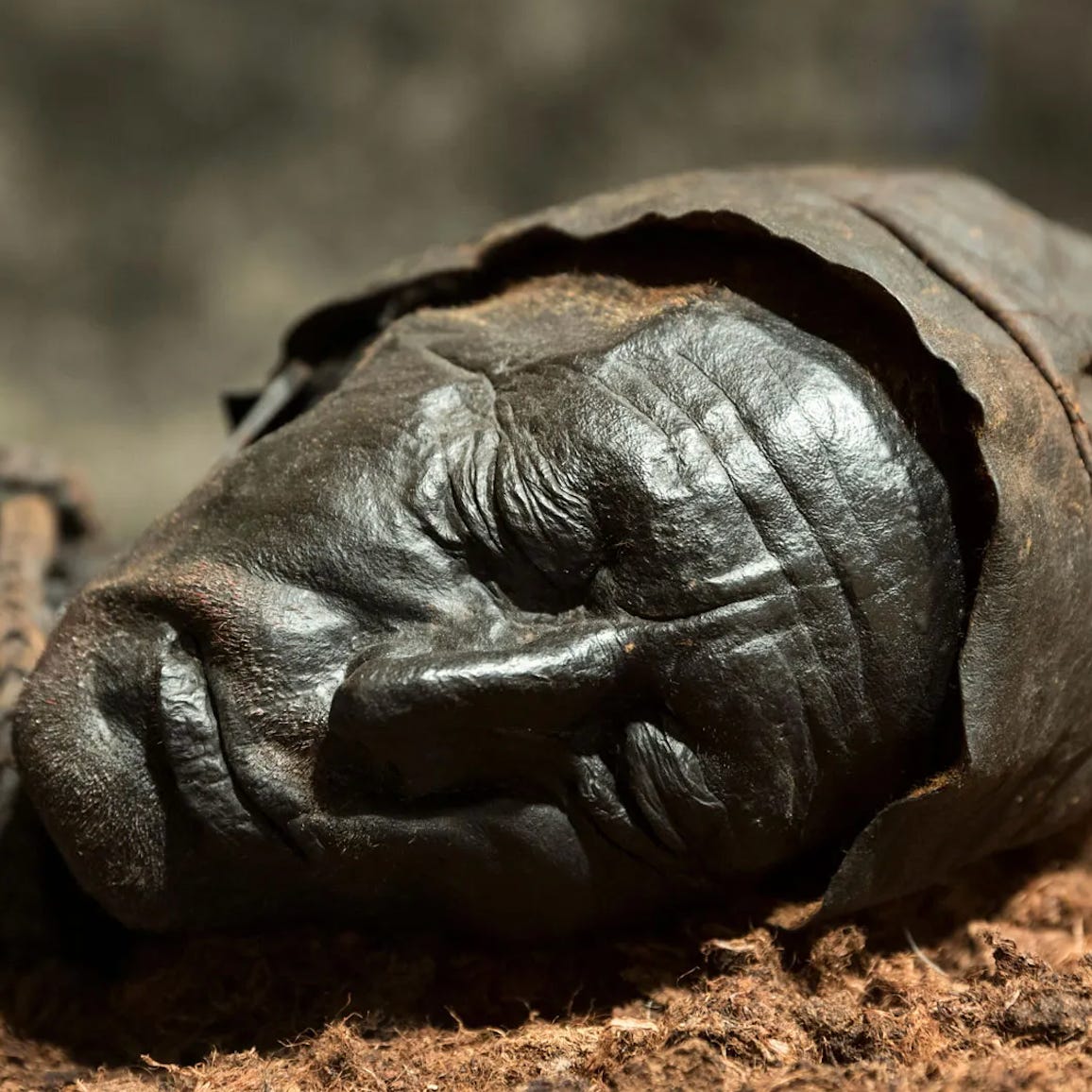
He was uncovered by a couple of blokes digging in a peat bog in Denmark, back in 1950. He looked almost as though he had just fallen asleep, but his skin was discoloured and drawn tightly around his frame - the effect of the chemistry of the environment in which he lay. There was a rope around his neck, so the police were summoned. They thought that perhaps whoever had killed him and dumped him out there could yet be caught.
But as it turned out they were almost two and a half millennia too late. He had died around 400 years before the time of Christ, probably in some sort of ritual sacrifice. He was so well preserved that you could see the whiskers on his chin and scientists were able to find the remains of his last meal (some sort of porridge) in his belly.
He was one of what have come to be known as the Bog People, whose number includes a two thousand year old British man, known colloquially as Pete Bogg, who had also met his end at the hands of others, in an area of Cheshire known as Lindlow Marsh.
Barnsley Poet, John Wolf brought the amazing story of the Tollund Man to the attention of the Read to Write Poetry group one summer evening, to feed our imagination, and perhaps inspire some creativity.
It had already inspired the Nobel Prize winning Irish poet Seamus Heaney, who had published several pieces about him. We read the one called Tollund Man there is a recording of Heaney reading it online. It is a fantastic reflection on sacrifice and simple lives in rural areas being touched by belief in something bigger than themselves - something worth giving up their lives for. Some suggest that the poem uses the deaths of ancient bog people as a metaphor for those who died in the armed struggle in Ireland. I’m not quite clever enough to read the mind and precise intentions of Heaney, but I think I can hear a suggestion of it.
In addition to reading the poem together, we examined a 1950’s book by Palle Lauring, a Danish man who came from what he called the “Land of The Tollund Man” in the title. The black and white photographs printed on chinagraph paper added to the atmosphere of the discussion. The magic happened. The fever began to grip me, just as John Wolf had intended. If Seamus Heaney could use the power of this wisened old cadaver as a creative spur on his journey to a Nobel Prize, then maybe I could use it to help me realise my poetic ambitions - maybe to get my name in print, or to create something that I could read on BBC Radio 4, perhaps even something which might eventually earn me the coveted poet laureateship! Or at the very least, it could inspire a page which would languish in a poetry blog in the backwaters of Substack.
With such dreams in mind, I began to wonder what it would be like to actually meet the Tollund Man, to speak with him, and with the people who knew him. Over such a vast distance in time it would be something of a one sided conversation, but I felt that it would be an interesting conversation to have.
So here it is…
Tollund Man
What would you say to the Tollund man
Peaceful in his repose
With his slumbering eyes
and his lips sealed shut
and his slightly crooked nose?

“Im sorry they hung you, whatever you did
You look much more like me
Than a skeleton does and because of that
You have my sympathy

Your face looks honest enough to me
In fact you look quite nice
Perhaps you were not a criminal
But a human sacrifice

The very idea makes my blood run cold
And sluggish through my veins
I shudder at the thought of it
As I gaze at your remains”

And what would you say
to the Tollund Man’s wife?
“I’m sorry for your loss?
So sad that a fellow as fine as he
Should lie in the sphagnum moss

For millennia and them some more
Placid and serene
Deep in the dank dark, ancient peat
Years and years unseen

Did you marry again or pine away
When widowed so suddenly?
Were you angry about what happened to him
Or did you let it be

Whatever you did
Doesn’t matter now
No matter how good or how rotten
It’s him we’re bothered with, not you
You’re both gone and forgotten"

And what would you say
to the Tollund Man’s kids?
If you should ever see ‘em
“Your daddy has gone to a better place
The Silkeborg Museum

Where, thousands of years since you have died
Your descendants will marvel at
The man preserved for millennia
In a unique habitat

Anaerobic, oxygen free
Where bacteria cannot thrive
Where a man can lay dead for a very long time
And look as if almost alive

Whist up above in the open air
Life has gone on pell mell
Generations have  perished
along with their dreams
And kingdoms have risen and fell”

And what would the Tollund man say to us
If he could wake up and speak?
Suddenly finding he’s no longer him
But in fact an amazing antique.

Perhaps he would say “Leave me be - go away
Stop all your prying and nosing
Get me out of this place, inter me again
And let me start decomposing"
Since writing this article I have come across a further piece of poetry/writing about the Tollund man on the fascinating Too Much Brudders site. I urge you to go and read it, then explore the rest of the stuff on there.
And, If you like gentle instrumental music from Jutland - check this out from the Barrowfolk. It has a lovely, nostalgic 1970s short educational film feel to it. Probably best heard through the speaker of an old black and white television.
When I first saw an image of Tollund man (age 15? 16?) I was already very much interested in archaeology. I was utterly captivated by it. As you say, it's not as easy to identify with a skeleton, but that face! The image was in Archaeology magazine (I think) I remember bringing it to school to show classmates. They were all horrified, thought it was disgusting. That still baffles me. Recently traveled to Mesa Verde National Park in Colorado with my family. We got a really stellar tour with a great guide and at then end my daughter (19 y.o. college student, but not studying archaeology) was so entranced by the place. She said, "I want to know everything now! How did they bury their dead, what games did they play, when they hummed a tune what did it sound like." She connected with people in the past in a visceral way. Your poem describes that same feeling. I really enjoyed it. Thank you.
archeology is one of my big luvs. Piltdown & such make it beautifully spooky. Did his wife do it, was it a perverse autosexual pleasure gone awry? Maybe not up Ilkly moor in winter. You can see some bog man in MacCaig too. I think it’s all the thistle and grist diet on which I too suck.
Fascinating piece Mike and once again Wolfe hits on a shared interest. From feyts in Kimby to t frozen wastes of the past… I like the multipersona approach. Under Ancient Wood. Theres corrupt corpses isn’t it