

2.42 Dorothy, Daffodils and Disciples
Was William Wordsworth's sister only there to make the sandwiches?


I’ve got a lot on my mind at the moment, and it is all my own doing. I have been setting myself too many tasks. It is so easy to start dozens of little projects and get to the end of none. Or maybe to finish them all at low quality, defeating the object of having started them in the first place. I have recently been given the opportunity to perform the gospel of Mark as a monologue. This is something that I have always fancied, but it takes a bit of time and effort. I don’t intend to learn it by rote, nor do I intend to read it out loud – Instead I want to learn the stories and tell them in my own way but even with this approach it still takes effort, thought and time.
In order to save myself some time, I had the bright idea that I would write this week’s article about the gospel of Mark, maybe with reference to the poetic language of the King James Bible. Unfortunately, as I read through, it became evident to me that the unique selling point of Mark, is that he is not poetic at all. He just wants to bang those stories out and inundate his readers with information on the remarkable life of Jesus Christ. He doesn’t want to charm with poetry, he wants to browbeat you into submission. OK! OK! you’ll cry. I accept him as my Lord and Saviour. Even though he is a little bit weirder than I thought he was, more occupied with performing exorcisms, healing the sick and raising the dead than sharing love.
All the time that I have been pondering these great theological thoughts. Dorothy Wordsworth has been insistently tapping at the inside of my cranium. You promised to write about me! She says. Never mind Jesus. You gave Coleridge and his awful teeth two weeks! You’ll probably get on to my illustrious brother at some point, and just pass me over without a thought.
Ok Dorothy. But just let me relate one story from Mark that I find particularly fascinating with regard to attitudes to women. It’s from the first chapter of his gospel, at a point where Jesus has just started out in his career and had only four disciples. They all go to Simon’s house…
…And forthwith, when they were come out of the synagogue, they entered into the house of Simon and Andrew, with James and John. But Simon's wife's mother lay sick of a fever, and anon they tell him of her. And he came and took her by the hand and lifted her up; and immediately the fever left her, and she ministered unto them1.
I’m no biblical scholar at all, but I read this as a bloke (and his brother) inviting a few mates around his house, maybe with the promise of something to eat, and when they arrive, the woman of the house is sick. The coolest bloke in the gang then heals her so that she can make them all a few sandwiches. The boys are doing all the important stuff. The woman is just there as support.
Does that ring a bell with you, Dorothy? Was it William and Samuel who were doing all the important stuff and you were just there to make the sandwiches?
Again, I’m no expert. I don’t know a great deal about the lifestyle of that particular trio and nothing at all about their domestic arrangements, but I know that they went for walks together, and the two blokes wrote poems which would be credited with changing the world of English Literature. However I am intrigued by the fact that Dorothy had literary ambitions of her own, and the legend that she might actually have written Daffodils.
When Dorothy’s writing is discussed, it is usually her journals that grab all the attention. She wrote about the countryside as she explored it, and she wrote about her companions. That’s how we know about Coleridge’s teeth. She wrote journals in Somerset, where she first came across him. She wrote journals in Hamburg, where the three poets travelled just before Lyrical Ballads, the book that would launch William and Samuel’s careers, came out. She wrote journals in Grasmere, where she and her brother moved to when they could afford to relocate, and she also wrote journals of trips to Scotland, and a further tour of Europe.
But she didn’t just write journals, she wrote poetry as well, and perhaps more often than not, the poetry sprang from the other writing. A journalist-poet, a bit like Edward Thomas was to become a century or so later2.
Even in Lyrical Ballads, Dorothy’s brother was using her notes and insights. He is fairly upfront about this in Lines Composed Above Tintern Abbey. A large section of which is devoted to her…
from Lines Composed Above Tintern Abbey - William Wordsworth
for she can so inform
The mind that is within us, so impress
With quietness and beauty, and so feed
With lofty thoughts, that neither evil tongues,
Rash judgments, nor the sneers of selfish men,
Nor greetings where no kindness is, nor all
The dreary intercourse of daily life,
Shall e'er prevail against us, or disturb
Our cheerful faith, that all which we behold
Is full of blessings.
He also credits her influence directly (although for some reason he changes her name to Emmaline) in To a Butterfly, which he wrote in 1802, after a conversation with her about the butterflies in the garden of their early childhood3.
To a Butterfly - William Wordsworth
Stay near me - do not take thy flight!
A little longer stay in sight!
Much converse do I find in thee,
Historian of my infancy!
Float near me; do not yet depart!
Dead times revive in thee:
Thou bring'st, gay creature as thou art!
A solemn image to my heart,
My father's family!

Oh! pleasant, pleasant were the days,
The time, when, in our childish plays,
My sister Emmeline and I
Together chased the butterfly!
A very hunter did I rush
Upon the prey: -with leaps and springs
I followed on from brake to bush;
But she, God love her, feared to brush
The dust from off its wings.
And yet he never made mention of her influence in the composition of what is perhaps his most famous poem, I Wandered Lonely as a Cloud, better known as Daffodils. In fact he credited his wife, Mary with what he considered to be the best lines in the poem “they flash upon that inward eye, which is the bliss of solitude”. This must have stung Dorothy, who was already less than happy about having to share William with her.
The sting must have been particularly bitter, as she had made the following observations about the daffodils in her journal,
I never saw daffodils so beautiful. They grew among the mossy stones about and about them, some rested their heads upon these stones as on a pillow for weariness and the rest tossed and reeled and danced and seemed as if they verily laughed with the wind that blew upon them over the lake, they looked so gay, ever glancing ever changing.
Dorothy is rapping on the inner wall of my skull again. Don’t you dare use the full Daffodils poem here. You promised to write about me! I take her point. I have something more planned for Daffodils anyway, and I really must finish with one of Dorothy’s own poems. Although, I will point out, that she has been quoted as telling a friend that… I should detest the idea of setting myself up as an Author." (Instead, I hope to) "give William Pleasure by (my writing)"
She certainly achieved that. But have a look at this piece, which Dorothy wrote after a walk around Ullswater and was never actually published until 2013. I think it’s rather good.
Floating island - Dorothy Wordsworth
Harmonious Powers with Nature work
On sky, earth, river, lake, and sea;
Sunshine and cloud, whirlwind and breeze,
All in one duteous task agree.

Once did I see a slip of earth
(By throbbing waves long undermined)
Loosed from its hold; how, no one knew,
But all might see it float, obedient to the wind;

Might see it, from the mossy shore
Dissevered, float upon the Lake,
Float with its crest of trees adorned
On which the warbling birds their pastime take.

Food, shelter, safety, there they find;
There berries ripen, flowerets bloom;
There insects live their lives, and die;
A peopled world it is; in size a tiny room.

And thus through many seasons' space
This little Island may survive;
But Nature, though we mark her not,
Will take away, may cease to give.

Perchance when you are wandering forth
Upon some vacant sunny day,
Without an object, hope, or fear,
Thither your eyes may return--the Isle is passed away;

Buried beneath the glittering Lake,
Its place no longer to be found;
Yet the lost fragments shall remain
To fertilize some other ground.
Just like fragments of Dorothy’s work fertilised the imagination of her brother.
If the article had been all about Jesus, I had intended to use the following Illustration at the top of it. I had toyed with the idea that it could actually be a picture of Coleridge, William and Dorothy before a walk. (you can even see the Quantock Hills through the window)
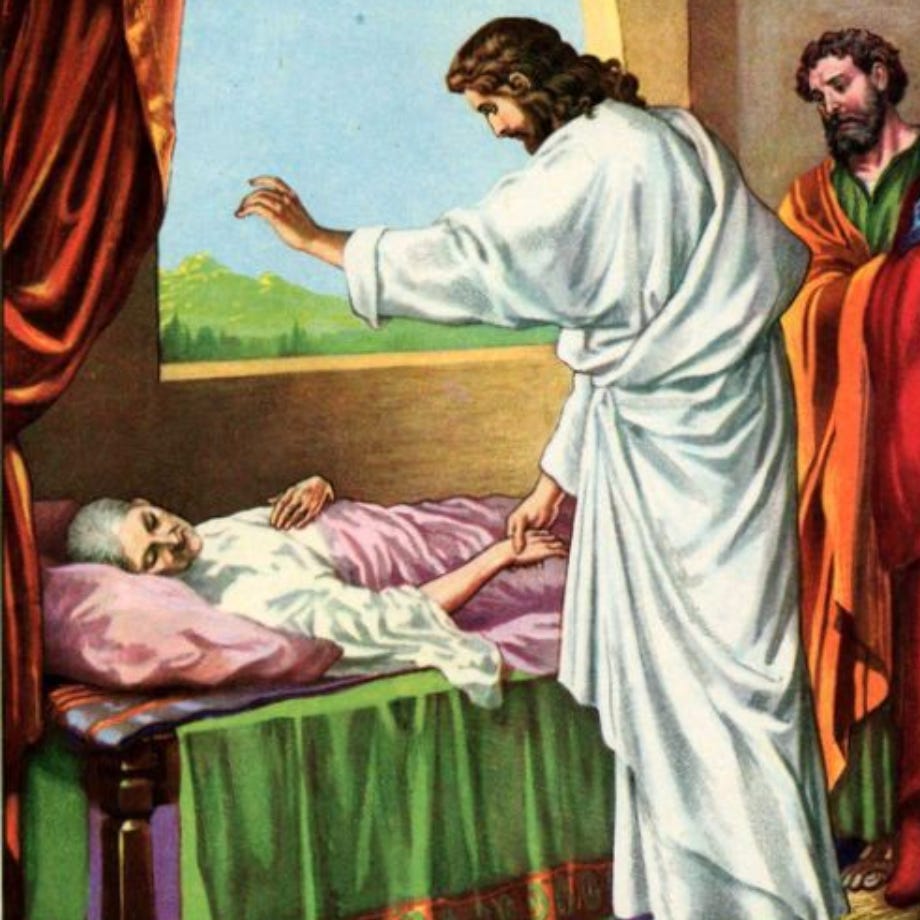
There’s another article that I shall have to write - Edward Thomas, Journalist-Poet!
They only spent the early years of their childhood together. At the Age of seven, their mother died, and Dorothy was separated from her siblings, going to live with a cousin and saw little of William for the next sixteen years. After re-uniting in 1994, they were almost inseparable.
Dorothy idol-worshipped William and let him (and Coleridge) ransack her writing for ideas because she didn't consider that she had any talent. The sun shone out of William's arse. She was a prisoner of her age, and it surprises me when she does make her opinions known. And they were all bonkers anyway.
What would the filling have been in the sandwiches, that was my first thought.