

2.53 Welcome to the Machine
The march of technology - Are our creations laughing at us.?

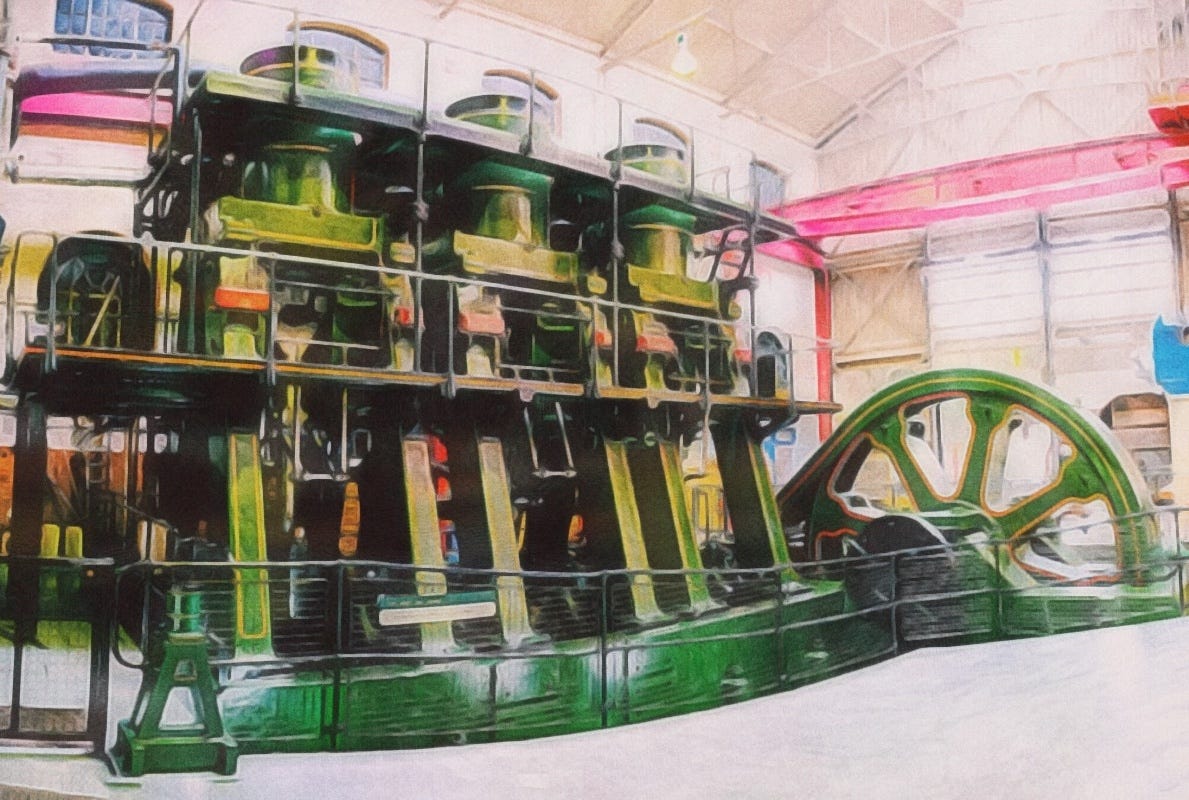
I live in South Yorkshire, home of the River Don Engine, the most powerful working steam engine in Europe. It is a magnificent piece of 1905 engineering which is fired up twice a day from Thursday to Sunday each week for the edification and entertainment of visitors to the Kelham Island Museum in Sheffield, the town where it was made. Weighing 425 tons, it is well over five metres high and probably twice as wide. The museum was built around it.
To watch it in motion is spellbinding, even to me, a man who is not generally excited about steam engines or indeed any sort of engineering at all. The technology is all a bit beyond me, but to see that thing pummelling away with its three massive cylinders, gigantic pistons plunging up and down, and huge flywheel spinning, it is like being in the presence of a behemoth, a monster which is incredibly strong, incredibly dangerous, and has its own smells, sounds and animated motion.
In its day, the River Don Engine was capable of producing huge sheets of sixteen inch steel plate for building battleships and was still being used in the 1970s to produce reactor shields at nuclear power stations.
When I read Louis Untermeyer’s sonnet Portrait of a Machine. The River Don Engine was the first thing that I thought of. The poem was written in 1922, well over a century ago now, long after the industrial revolution had wrought its first changes in the world and even longer after the Luddites had embarked on their campaign of wrecking the mechanisms that would put many of them out of work. Untermeyer, would have been 20 when the River Don engine was built, and being an American would probably never have heard of it, but there were equivalent machines in striking distance of his Native New York. The Bethlehem Steelworks in Pennsylvania would have had something like, and the Allis Chalmers expansion engine in the Phillipsburg Pump House, New Jersey is still operable today. Then again, he might not have seen either of these and have been thinking about some other magfnificent engine when he created this portrait in words
Portrait of a Machine - Louis Untermeyer
What nudity as beautiful as this
Obedient monster purring at its toil;
These naked iron muscles dripping oil
And the sure-fingered rods that never miss.
This long and shining flank of metal is
Magic that greasy labour cannot spoil;
While this vast engine that could rend the soil
Conceals its fury with a gentle hiss.
It does not vent its loathing, it does not turn
Upon its makers with destroying hate.
It bears a deeper malice; lives to earn
It’s masters bread and laughs to see this great
Lord of the earth, who rules but cannot learn,
Become the slave of what his slaves create.
Untermeyer’s sonnet starts off as an awed tribute. It even sounds a little bit homoerotic with its naked iron muscles dripping oil, but by the end, there is a sense of foreboding. Those last four lines with the mention of malice towards its makers and the possibility of us, the Lords of the earth becoming slaves to the machines that we have created.
We have seen many revolutions since the 1920s, the rise of telecommunications, computer technology, the internet, and now the rise of artificial intelligence. Are these creations, like Untermeyer’s machine, laughing at us, as we have become slaves to them?
My dad used to call the television the one eyed god in the corner. It didn’t stop him watching it virtually every night from teatime until bedtime though. I remember people applying the famous Karl Marx quote about religion to television, calling it the opium of the people. Nowadays the power of the television seems almost benign compared to the power of the internet enabled smartphone. I have largely avoided the influence of the television for years, cherry picking the best stuff it has to offer and doing my damnedest to avoid the adverts. But I cannot resist the lure of the smartphone and the internet, and no matter how many ad-blockers and filters I apply, it still holds a considerable sway over me. It isn’t just advertising that is the danger, it is those persuasive opinions, founded on dubious facts, that can’t be avoided. They creep into the consciousness of all of us, eating away at our ability to concentrate, corroding our sense of reality, influencing our relationships with others, manipulating our political beliefs, changing the outcomes of elections. The telly never did much more than try and sell us detergents, clothing and food. It was working for Capitalism, yes, but after a brief golden age of discovery, the internet is working to influence our every thought, all at the behest of a small minority of billionaire technocrats.
And now artificial intelligence. If any of our creations are able to laugh, at us artificial intelligence is laughing the loudest and hardest. I am not even thinking in terms of taking over the world and eliminating the human race. I am just thinking of the ability of Large Language Models to gobble up all of our words and ideas, chew them up and spit them back out at us disguised as original thoughts. Obviously as someone who enjoys writing, I worry that such machines will put writers out of work. Not just poets, novelists and journalists, but scriptwriters, philosophers, politicians, and any kind of communicators including those in visual arts, even music. The internet is now beginning to groan under the weight of artificially produced content. And content is all it is. Just as television and radio have largely gravitated towards ‘content’ which is cheap to produce and gives us a reason to watch the adverts which make the money, the internet is shifting towards cheaply produced content which not only leads us towards advertising, but towards lazy opinions and ideas, crushing our creativity and individuality as it does so.
Because artificial Intelligence creates its content by examining the stuff that is already out there, chopping it up and feeding it back to us, there is nothing original in it. Worse, the more of the content out there that is created by artificial intelligence, the more of it will be gobbled up again by the machine learning itself and fed back to us as second third fourth generation ‘content’ ad infinitum. The danger is that the majority of both consumers and creators of ‘content’ will not be human at all. All we will be doing is reading articles on the ten best ways to avoid reading anything actually interesting, and then flicking on to the next twenty second video clip, which is also probably created by artificial intelligence.
The bovine spongiform encephalopathy (BSE or mad cow disease) epidenmic in the 1980s caused British Beef industry to go into meltdown. The CJD variant was transmittable to humans too, causing all kinds of problems including dementia and death. It was eventually determined that a major cause of it was feeding cattle on the waste products of the meat industry, their dead relatives. The produce of artificial intelligence seems like that. It will eventually be fed largely on its own produce, and who knows what the damage will be.
Am I ranting? I’m sorry if I am ranting. Perhaps I’m wrong. Perhaps in some distant future, Artificial Intelligence will seem as benign as steam power, or television. And yes, I am sure that it has some fantastic applications in identifying the early signs of cancer and performing really delicate surgery and lots of other scientific processes that I can’t begin to imagine. But I can’t help thinking that once we have no incentive to think for ourselves, then we will be in decline as a species. What do you think?
I had wanted to wrap things up with a poem that I had written some time ago on the subject. I was sure I had it somewhere on the my hard drive. After a long search I found it in a folder marked accepted. According to my notes it will be published in late January 2026. I’m not boasting of anything but persistence. It had already been rejected by Penstricken1, Eunoia and the Frogmore Press before Ionosphere accepted it. Not to worry. I give you another one on a similar theme, one which both Ionosphere and Penstricken have rejected. It’s not quite as appropriate, but it will have to do.
My New Device - Mike O’Brien
My new device had finally arrived
I could hardly wait to get it out of the packaging and fire it up

I carefully put my fingers into it
A manicurist in Paris polished my nails

Feeling a little braver, I put my hand into it
A masseur in Singapore eased its tired ligaments

Excitedly I put my arm into it
A tattooist in Tokyo decorated it with a fire breathing dragon

Regretfully, I put my arm back into it
A surgeon in New York removed the tattoo

Enjoying myself by now, I put my foot into it
A chiropodist in Baltimore trimmed my corns

Really buzzing, I put my leg into it
A tailor in Harrods measured it for some trousers

I took the plunge and put my head into it
A barber in New Delhi gave me a haircut

Recklessly, I put my whole body into the device
I was downloaded
And digitised
Into binary
Transcoded
To Hexadecimal
Optimised
Transcended
And cleansed of flesh and bone
Forever
I actually paid to submit to Penstricken. I didn’t have to, but if you sent a donation, they promised to reply more quickly and send you some comments on your submissions. As the forthcoming issue was on a theme of machines, I felt quietly confident. More so when I received their encouraging comments. Alas, they rejected me. I have no hard feelings. You can read the issue with all the stuff that they accepted here. The poem that Ionosphere accepted was called A Moment of Doubt, After they had accepted it, I received a second acceptance from The Penmen Review and had to tell them that they couldn’t publish it after all. No worries, they went on to accept another two of my pieces - Look! (Now I am boasting, I shall shut up. It doesn’t become me)
I just kept nodding all the way through the article! When you got to BSE, that reminded me of reading how slurry which includes human waste is now sold by the water companies at a discount to farmers for them to use as manure. I find it difficult to understand why things like AI can’t be used selectively for the applications which are useful to humans, and the ones that threaten to destroy what makes us uniquely human left alone, but I know it’s all just about money.
A whistle-stop tour of the beast that is technology Mike, and the pinnacle (or nadir) in the great summarising machine, the LLM.
I read Proust some decades ago, and it took me a whole year. AI might do a good job of summarising Proust, and so much better than the entrants to the Summarising Proust Contest as imagined by Monty Python.
The serious part is this: on the radio this morning was a programme about childrens' neural normality being rapidly rewired by phone and tech, and a serious addiction by what was referred to as 'behavioural cocaine'.