35. Stuff
... being a consideration of our relationship to material possessions.
Is it human nature to hoard things that we value? Obviously there is an evolutionary case case for hoarding food, and we are not the only creatures to do it, but hoarding other stuff? I have detailed elsewhere about how I hoard books. There is no need for it. It is a luxury pursuit, but one that I feel compelled to do. I have been the same in the past with music. I still have a pile of old vinyl records, I don’t ever play them, and the sound quality is infinitely inferior to CDs after I wilfully mistreated them in my youth, but I find it difficult to countenance throwing them away. I did throw out all but a handful of my cassette tapes some years ago with perhaps just a twinge of guilt, and I still own a large selection of CDs, rarely played. Digitisation helps, but I don’t trust the permanent nature of digital files - one fault with a hard drive and the lot has gone. Those CDs are backups. Sites like Spotify and Deezer are not the same. There are huge gaps in their collections, and I hate the idea of having to pay for music every time I listen to it as opposed to buying it once (or downloading it from somewhere) and owning it for the rest of my days.
I did try digital books once. In fact I still have two Kindles, and a Kobo. Whilst they are great for reading they just can’t compete with the thrill of ownership and all the sensory gratification that comes from having a real bookshelf with real books on it. I would throw away my entire CD collection tomorrow, if it meant keeping the books. Well.. almost my entire CD collection. Some of them are irreplaceable. Music from people who I know or have known. Mostly cheaply produced in editions in editions of a couple of hundred or so. A bit like my collection of poetry chapbooks.
What will happen to all that stuff when I am dead? I am sure that 99% of it will be thrown away, sent to the skip for landfill or for recycling. Some of the stuff that is destined for that fate might actually be worth something, but it will probably be too much bother to sort it out from the rest of the worthless junk that it is hidden in. The other 1% will either be sold for its recognisable value, or kept for sentimental reasons, becoming part of the collections of other people to be more than likely thrown away when they die.
Over the last decade or so, both of my parents have gone to glory. Judy has gone one better, saying farewell to two parents and a step-dad. Each of them left all their worldly goods for us to dispose of. The two dads were the worst, because they were proper hoarders. They had remained in the same houses for decades, collecting and saving items from their working lives, their hobbies and interests and plenty else besides, most of it was stuff that they hadn’t really used for years and never got around to throwing out.
A lot of the stuff that the dads left behind was tools. Tools are a mark of manhood. You have to have the right tools for the job. My dad, Cyril, left the usual hoard of spanners, screwdrivers, chisels and saws, most of which have since been integrated into the mass of tools on the table in my garage. He was a watch and clock repairer, so he also had quite a collection of miniature tools, tiny pliers and files and tweezers and bits. He also left a multitude of cogs and springs and flywheels and cotter pins of all shapes and sizes, along with oils and chemicals and larger items such as an ultrasonic cleaning machine which looked like it dated from the dawn of ultrasonic cleaning back in the 1950s, a disassembled grandfather clock and countless other timepieces.
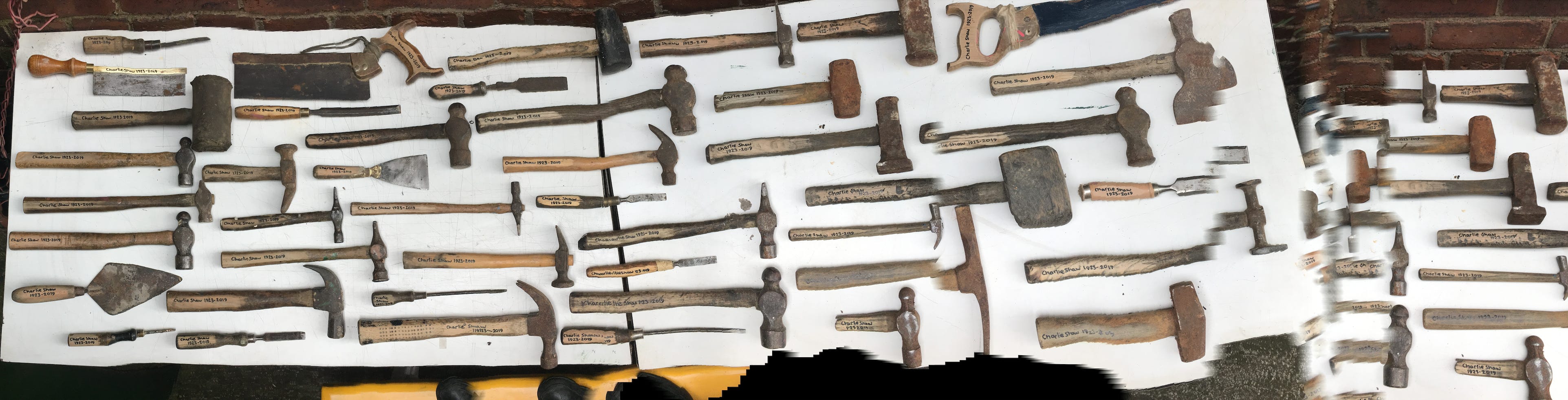
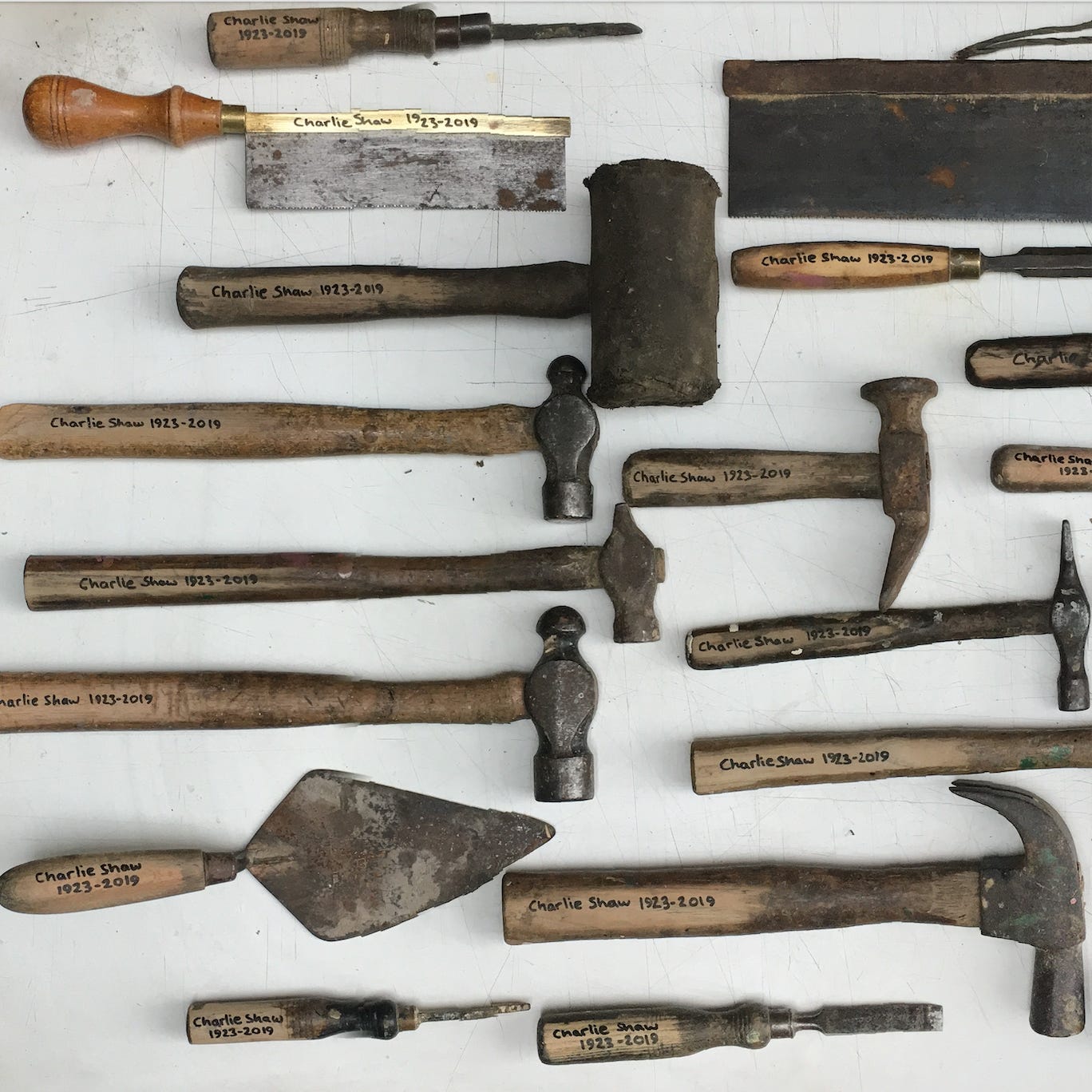
Judy’s dad, Charlie was a mechanic. He had worked on bicycles and cars in his long career, before becoming an odd job man in his retirement, and doing a lot of work in wood. His house was absolutely packed with all manner of tools. He must have had literally dozens of screwdrivers, and saws, and hammers, and chisels, and thousands of screws and nails, and stacks of wood. Some of those too have found their way into my tool hoard, but only a small portion of them. There were so many that, for his funeral we selected a large amount of the ones with wooden handles and inscribed his name and dates on them, and left them out on a table in his garden for guests at his wake to take home.
Whereas Cyril had a wife to ensure that his hoard didn’t spill far from the boundaries of one room, Charlie was divorced and lived alone. He arranged things so that his living quarters were on the first floor of his house, leaving the ground floor and outhouses to be piled high with all manner of stuff. Some of the rooms only had a small path through the middle of them with deep walls of stuff on either side. He had worked for the South Yorkshire Times when newspapers moved from hot metal presses to computerisation and part of his job had had been to dispose of a lot of stuff that was no longer needed. He did this by filling up his house with it. Some of it had antique value, there was a large metal guillotine that could be used to cut the edges of vast stacks of paper and a printer’s desk with much of the metal type still in it along with a collection of metal photographic plates. Some of it was less valuable, old doors and windows, office chairs, ancient filing drawers, reams of paper, odd bits of wood and metal and plenty else besides. Along with his photographic equipment, books, records and photographs (in negatives prints, slides and on CDs), it took us over a year of weekends to sort everything out.
I wrote the poem Stuff some time ago, when Charlie and Cyril were both still with us1. We had already had to start dealing with their stuff though, My dad had moved into a nursing home and as Charlie’s ability ability to get out and meet people declined, he wanted to have gatherings on his garden patio. We had to clear stuff from both that area and the access routes to it to make them practical.
A dozen or so years later, I can see the problems that my stuff will cause others as I myself take the declining route to my grave. But that doesn’t make it any easier to sort things out. I can recommend a book The Gentle Art of Swedish Death Cleaning2 by Margareta Magnusson, which attempts to give practical advice on decluttering and helping the people who will have to deal with your stuff when you are gone - but I am better at reading it (and hoarding it with all my other books), than I am at actually following any of its suggestions.
Perhaps, for slightly different reasons, I am as addicted to stuff as Charlie and Cyril were. I define myself by it.
Stuff
My parents’ generation knew the value of stuff
They had lived through a war!
Stuff had been scarce
They had to make do and mend
They didn’t like to throw anything out
They hoarded
“It might come in handy”
“There’s still a bit of life left in that”
“Good, solid metal”
“A nice bit of wood”
“It just needs a rinse”
“Delicious!”

My parents’ generation grew old
Grey, weak and stooping
Their spaces became stuffed
Stuffed with stuff that never did come in handy
And now it never will
Messy stuff
Dusty stuff
Filthy Stuff
Useless stuff
Stuff they couldn’t move for
Stuff they couldn’t move
Stuff that was up to the likes of you and me to sort out
When they had passed on to the great beyond
If we could be arsed.

My generation know the value of stuff
Stuff is good
When it works
When it doesn’t
Throw it out
Stuff is great
When it is in style
When it isn’t
Throw it out

We define ourselves by our stuff
We need to choose the right stuff
The stuff that represents us
None of your tat
If we get it wrong
People will misjudge us
They won’t see the real us
All they will see is crap stuff
They won’t understand

Our stuff is more important than us
Without our stuff we are nothing
You can do anything to me
Anything you like
You can do anything
But don’t tread on my blue suede stuff

Imagine being you
Yourself
Without the need for any stuff
Other than that which sustains you
And keeps you warm

Immune to the adverts
Unswayed by the opinions of others
Cutting your own path
You
Yourself
Without any stuff
I have since changed the last few lines of the second stanza, to reflect the fact that they are no longer with us - it previously read
Stuff that it is up to the likes of you and me to sort out
Whilst their backs are turned
If we can be arsed
Looking the book up in order to provide a link, I have discovered that it has recently been made into a television series - it might be worth watching, if it re-enforces the message that I ought to start doing something soon.