

58. Bookcases
...being a look back at a difficult time for all of us, and some thoughts on how it affected creativity
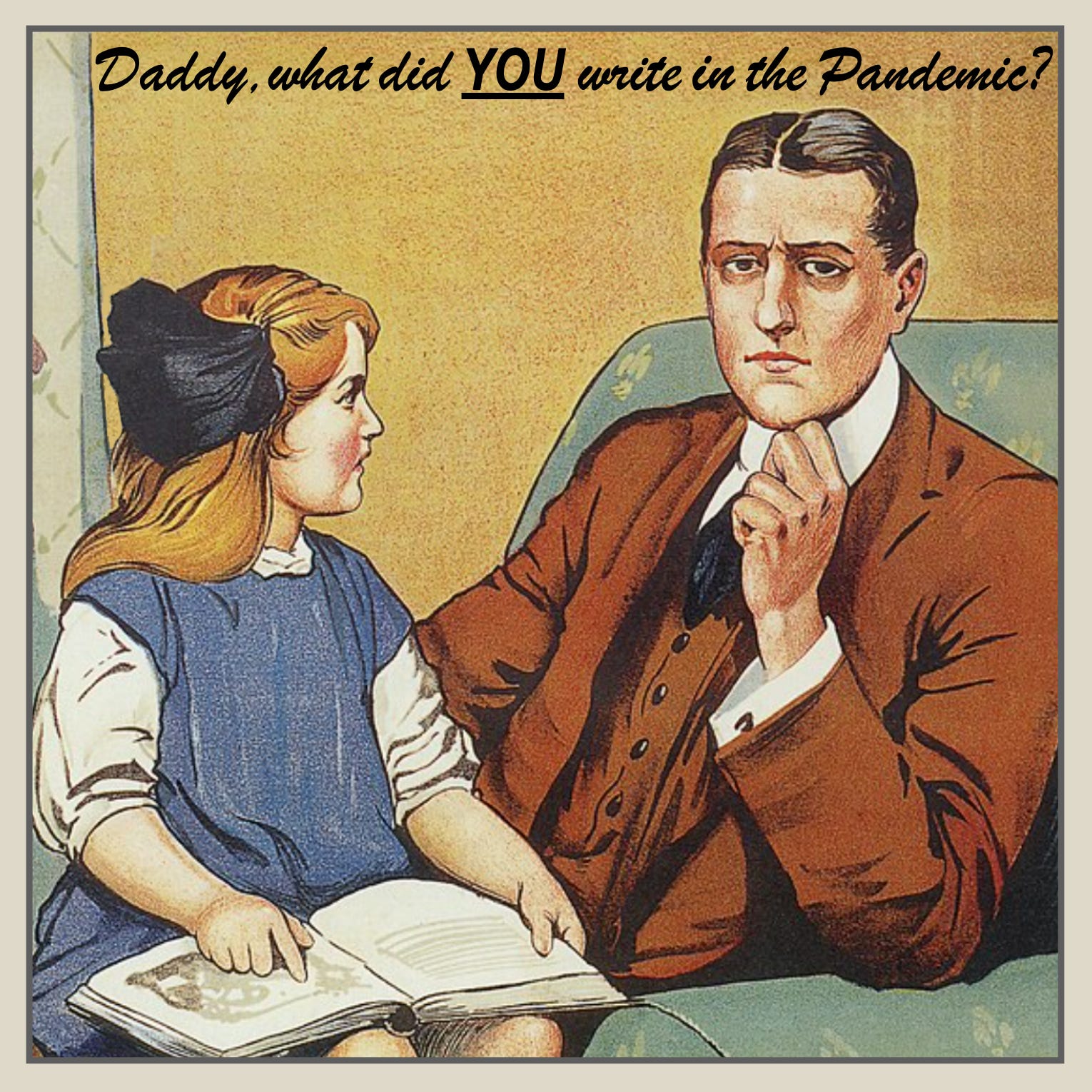
Its hard to believe that its only five or so years ago that we were living in a world where hardly anyone had heard about the Corona virus. The pandemic changed our world in so many ways. It was much more than something that made us all feel vulnerable in a way that we hadn’t felt for a long time. It disrupted all of our lives. Those of us who survived it were all transformed to some degree by the experience. Between January 2020 and March 2022, it is estimated that almost six million people around the world died of covid, 160,000 of them in the UK. Obviously the impact of either of the two world wars was much greater, but I would argue that to people who had no direct experience of a world war - anyone born after the early 1940s, it was a similar watershed moment. We all have pandemic memories and pandemic stories, and we can all compare our lives before the pandemic to our lives after it. It affected our attitude to work, our trust in the government, the quality of young peoples education, our mental health, our connections to links with the local community, and many more aspects of our lives.
I was one of those people who went to work throughout the whole period. Teaching in a special needs school, we were obliged to keep a service available for children with an Educational Health Care Plan. If parents wanted to send them in, we had to accept them. Many parents chose not to, and many staff decided to stay at home due to health reasons or increased anxieties. I didn’t feel that going into work wasn’t so bad. In fact it provided a chance to speak to people outside of the family bubble, and besides, school life was much more relaxed than usual. We had much smaller groups to deal with and there was no real expectation to adhere to any sort of curriculum. It felt more like how teaching might have been in the 1980s, before I started, and before the National Curriculum was brought in, during the dark days of the Thatcher Government.1
For people who write, the situation brought a unique opportunity. Being forced to stay at home during the lockdown periods, it must have occurred to many, that here was a rare chance to get on and write something. Even in my case, work notwithstanding, it felt as if I had suddenly been granted not only the luxury of the time to write in, but also a ready made subject to write about. We could philosophise about the situation and its impact. We could tell tales of what we had seen, from the large scale political manoeuvrings, and scientific advances, to the everyday stories of people going about the business of daily living. We were right at the centre of an event of global significance. How could anyone who imagined themself to a writer not take the opportunity offered?
Easily.
Perhaps the situation magnified the frustration that I feel about creating art. How can I produce something unique and true to my own experience? What can I find to say that isn’t being said by hundreds of others, or has already been said by thousands of other people before? It felt as though writing about the pandemic was immediately boring and old hat. There would be so many other people at the same game that it would be virtually impossible to be original.
In addition, I quickly discovered that even though I had imagined that solitude would be a great aid to the creative process, when presented with an abundance of it, the lack of contact with like minded individuals can be stifling. Pandemic meetings with fellow poets were all done by zoom or some similar internet technology, as were so many other meetings and family gatherings. This form of contact felt sterile in some way. Business could never be moved down to the pub afterwards for a period of reflection and unwinding. The Read to Write group carried on, largely through the hard work and perseverance of Mick Jenkinson and Tim Fellows, who put in an incredible amount of time and effort. But It didn’t feel anything like as comfortable for me. I would log on to a meeting, join in with some discussion maybe participate in a read around, and then I would turn off the screen and be instantly back at home. It felt deeply unsatisfying. It was at this point that I probably began to feel that poetry is shit. I gradually began to slide into depression, the onset perhaps augmented by the effect of a couple of bouts of actual covid.
In the early days of the pandemic, when everyone was desperately trying to stockpile toilet paper, dry goods and canned foodstuffs, it had almost been fun. I spent some time writing and recording a satirical song which I put out on YouTube. But that was probably my last, half hearted attempt to become a pop star, other than the final online hurrah of Pocketful O’Nowt, the band that I had been in for almost a decade. Beyond that, I scratched around on Social Media, writing lengthy replies to circular requests for posts about “Ten albums that have been the greatest influence on you”, and lengthy rebuttals of people who posted praise for how Boris Johnson was handling the situation in Churchillian style and tapping in to British qualities of exceptionalism and stoicism in the face of adversity. It was all too easy not to create anything of substance at all.
I think that I was almost completely out of the habit of writing when Mick Jenkinson contacted me about “View From a Locked Down Land”, an anthology that he was working on featuring members and guest poets from Read to Write. It is still available to read in its entirety online at the link above. I can remember my response was to put myself in the position of my future self who would have recovered from the depths of ennui and would look at the publication without me in it and would be disappointed that I hadn’t taken the opportunity to contribute. So I contributed two pieces. One being a anti-nationalistic piece about the English Flag, and the one reproduced below, about television interviews during pandemic times, which doesn’t actually mention flags at all, although the Union Jack was becoming an increasingly popular symbol to place behind people broadcasting about the national situation, as were the bookcases. which I built the piece around.
Mick, thanks for getting in touch and getting me to contribute something - It saved me developing the dreaded “Daddy, what did You Do in the War?” face.
Bookcases
We can trust in an expert who’s in his own home
With his skype or his zoom or his camera phone
In front of a bookcase, that’s filled up with lines
Of journals and volumes, all with perfect spines
If he’s got stuff like that then he’s clever indeed
And he’ll never get bored when he’s all that to read
And he looks so calm and we feel so distressed
So we’ll do what he tells us to do for the best

And the government minister he’s at home too
And we have to give credence to his point of view
As he’s sat at a desk with a lamp and a globe
He’s a man of the world with a mind that can probe
All the issues we have and he’ll deal with them well
And that bookshelf behind him, we can almost smell
The leather-bound volumes of Hansard on there
So, we’re safe to entrust him with our welfare

But here’s a man standing outside in the street
In casual clothes, with trainers on his feet
He’s questioned and filmed from 2 metres away
But there’s no real import to what he has to say
There’s no fancy desk nor a bookcase on view
So his words can’t be seen to have any value
His opinion means little when all’s said and done
He’s a vox pop, amusement, only for fun
After the education act of 1988, teachers were increasingly no longer trusted to operate under their own initiative, but to follow prescriptive ‘guidance’ requiring mountains of paperwork and fabricated justification for every decision made. It was the same for many other professions as well. Maybe regulation has improved some aspects of our lives, but professionals in Education, health, local government and many other occupations lost a lot of autonomy. The pandemic brought much of that autonomy back - albeit on a temporary basis.
Stunning expression of pre and post pandemic reflections. Being both writer and musician (or rather musical instrument player, let's say) your every word resonated. Excellent work. And the poem good, too.
Panem - ic.
For me it was a time of freedom - to get on the (motor)bike and enjoy roads that felt like nineteen-forty something. Occasional police riders acknowledged my nod, presuming perhaps I was a key worker - bikes were out fetching and carrying for the NHS. And my decision to ride was considered, before anyone jumps in about irresponsible, like having an accident and diverting medical staff to a self inflicted harm. Ask yourself first, has no-one ever had an accident (DIY or otherwise) at home/in the garden/walking round the block? I kept myself safe out of habit (adnaced rider) anyway and to get to the nub of that, what a joy it was to be free of vehicular numptyism. And be able to stop and hear....birdsong.
But I've always written something or other, regardless of company or lack thereof. Actually, I prefer my ownsomeness. It was never a concious decision. As a kid, you didn't go round for your mates and ask if they fancied 'writing out'. Growing up in the 60/70s any sort of liiterary group was rare, especially in the West Riding or whatever the dickheads renamed it. And actually admitting to writing - heaven forfend being a poet - was liable to encourage severe and frequent beating, taunting and mockery - even from girls who you knew secretly liked it. By my early twenties it was verging on OK among arty types 9but not punks, they'd rather burn books). But even I would join with my mate as we passed a poet's bedsit, drunk as the dark, dark night, in comments like "see the light in yonder window, for the poet is at home". We'd snigger all the way home 'speaking poet'. Cursed be the day he ever caught us - we might have learned something.
I have oft thought (no, this is me now) about the bookcase thing. Item placement is all part of the mise en scene in creating a shot/photo that works. Can a judge pronounce you're guilcup with no wig? My home is understated bookcase wise these days. It stems from the need to add a washing machine, some chairs etc and having limited space. So the content thereon is changing and focussed. Focus is Latin for hearth since you ask. Still, much as we love a given tome, how regularly do we re-read it? There are some items I don't think I could let go. Rock Dreams - OK it's a picture book, but it defined my generational cross-over youth, from R&B (the real one), rock and roll (the real one) and pop into psychedelia, rock and protest folk. Ok and blues revival.
Then there's Rock Griffin's erm, I forgot the title but its his art (with some text - think those eye creatures with arms n legs, Hispanic martyrdom/knights and Dali-esque acid-trip visions); again, a pivotal literary lump that has lingered long after "Hells Angels", other similar items by Sonny Barger and Snappy Jack, Kerouac's "On The Road," "Fear And loathing", Castenada, De Bono, whoever wrote Survival (about squatting and carpet tiles etc), The "Acid Test", Lobsang Rampa and more phooey than you can imagine slipped away. They made room for Maria Correlli, something on "Animal Magnetism" I wish I still had, something about prana, Hessian House Plant guide, Snow Blind, Portnoy's Complaint and watching Easy Rider/Cabaret and some Cheech and Chong business. Oh and architectural catalogues from yr dot for my business.
When I joined a virtual (see pandemic) open mic, I'd stand in front of the bookcase arsing about with whichever guitar was flavour of the moment. And it was slowly dawning that I liked my voice less and less, and tried to compose instrumentals instead of songs. As I chopped and changed guitar loyalties, I was less and less at home with any of them. The bike rides got posted not with photos but with ever more elaborate reviews. I found myself unconsciously finding better ways to describe motorcycling; the poetry and songs about it are horrid, redolent stereotypical bletherings. Don't write what you don't know, you'll make yourself look a twitter and bikers'll be quick to advise you, with some brevity. Born to be wiping my arse. Get some imagination (actually Steppenwolfe did a good job, I'm unfair with that, it's the chuffing media who bang it out if you do 11mph in a bleeeeeedin milk float). Where was I?
Oh, Mike O'Brien's post...I didn't think I'd harp on sae much, but once you start... I think he created a good poem about this (as indeed just about any) subject (experts, bookcases, teaching and Panem) - but my tastes are such a narrow band - the more I read the finer it seems sliced. I picked up Dryden today (thank you John Beal) and call me a political @@@3&**, when I saw he'd walked at Cromwell's funeral my eyes narrowed. Cromwell was England's premier Margaret Thatcher of course. Then I saw that he'd converted to catholicism - opposite tack to me. But it's perhaps the language of the past that either allures or repels. I er towards folk/colloquial and free verse - but not so much as dots, dashes, numbers and random thought burst that is obviously trying to impress. Paint yourself grey an' stand to one side, fffs:). Oh it moved. Meh.
I digress. There was something else Mike mentioned that set me off...oh yes, education. My professorial hindsight burgeons by the wasted minute. Having alumneseses in MGS and PPX I can see how grammar ed directs towards office, and secmod deflects us directly to the pithead/forge, whatever. You - well I didn't know that at the time. I believed all men (and even women, harrrrrupmht) were equal. Naiive eejit. There used to be two iis - the OED just pander to trends thinking it makes them cool and sells copy. Sellz. Grr, manic outburst. Anyway like so - My first foray into education was quite impromptu. The umpteenth person came up to me after a gig and said "how did you do this/that, etc? I had no blinking idea.
I thusly decided to watch myself playing (oh god I do not look cool) and try to create some kind of terminology that people could grasp. But words aren't right for some people; they like to watch (birds n bees anybody?) while diagrams or text are for others. Don't want much, do they? So no-one was after music grades; they wanted showy tricks or perhaps even musicological dexterity to enable their composition/advancement. Practise then I said, failing that, practice. People were saying they'd pay for lessons. It wasn't entirely an altruistic decision to agree to this, ask any starving musician. Even the ones getting plaudits are cannon fodder as far as venues are concerned. It was ever thus.
So I had to devise courses, decide on suitable curriculae/ism and ask others how much they charged. No wonder they didn't get many students. I entered the market just up from Woolworths prices. I got kids on The Joke Of Edinborough Award and godwot until one day a teacher with the WEA asked if I'd take over his beginners, as his intermediate demand had grown. Thank you Robin Hoare. I was teaching classes of forty-odd. So I split them into sections, taught each section different parts and got them playing ensemble. Jesus, it actually worked. And kept them busy while I tried to get round fotty students in an hour...
Here's where I get back to O'Briens, as they say. The lovely June Fisher (WEA, RIP) asked if I wanted a free teacher training course/qualification. "Oreet goo-on luv" I says. Didactic, pedagogic, gingang goolywatcha; prep, post mortem. Even an unexpected question had to be documented. I'm afraid that as my Dip Cert already qualifed me to teach, I left the course. And the job, because despite the progress the class had made under my governance, the WEA weren't satisfied - not even with growing numbers. It was there way or no way, as we dynamicists bleat on. I gave them a nanosecond notice and rode my rebel born to phking hoover up motorcycle the hell outta there and never looked back. Or, briefly, any governing body anywhere in the world has no more idea than fly (help me etc).
Great article Mike, it got me going....